Seed-starting
by Pat StoneAny gardener can appreciate the benefits of starting plants from seeds. If you start your own seeds, you have a much greater variety of vegetables, flowers and herbs to choose from than if you go down to your local garden center to pick up six-packs of nursery-raised plants. From old-fashioned sweet peas to French tomatoes to tasty basils, seed-starting opens a world of plants to explore and enjoy right at home. You'll also be able to give your starts special, personal care and to time your sowings so the seedlings will be ready to go into the ground at just the right time for your area.
Seed-starting may not seem a simple task if you've never done it before. Yes, a number of seeds will do fine if they're sown right out in the garden when the weather has warmed in spring. But with many vegetables, flowers and herbs, you'll want--and need--to get a jump on the typical U.S. growing season by starting the plants indoors several weeks before it's time to set them outdoors. That's because many plants won't flower or bear fruit unless they are given a head start. Our summers just aren't long enough. Playing nursemaid to a houseful of infant seedlings does require time and energy. Light, moisture, fertility, temperature and timing all must be managed with care to raise healthy seedlings. What follows is a guide to help you shorten the learning process a little. After you've done it once, seedstarting will seem easy and routine.
Let's begin by breaking the operation into its basic components. Remember as we go that seeds and baby seedlings are two different things and that you have to treat them differently. It's like caring for a baby in the womb as opposed to caring for an infant in the nursery. Each has it own particular needs.
WHAT SEEDS NEED TO GERMINATE
SOIL
The first step is to make sure you've got a suitable growing medium for your plants. It must be light in texture and must allow excess water to drain away rapidly. Don't (repeat, don't) use plain garden soil. In a container, it drains poorly and turns adobe-hard after a few waterings. You can probably find a good-quality growing mix locally, or you can order the extra-fine seed-starting mix sold in the Shepherd's catalog. Some growers make their own mixes from such ingredients as horticultural vermiculite ("popped" mica flakes), milled sphagnum peat moss and perlite. These materials are very light and hold moisture well. For beginners (and for many experienced seed starters), a commercial mixture designed for starting seeds works just fine.
CONTAINERS
What will you put your growing mixture in? Cutoff milk cartons, disposable aluminum pans, special seed-starting containers such as those offered in the Shepherd's catalog--all will serve. They need to be at least 3 in. deep to allow room for roots to grow, and they must have small holes for drainage so roots won't rot in soggy growing mix. Many gardeners prefer to make traditional wooden flats (14 in. by 12 in. by 6 in. is a good size). Leave gaps of about 1/8 in. between the bottom boards so extra water can drain away. Line the bottom with newspapers before filling homemade flats with growing mix to keep the mix from washing out. Note: Some gardeners grow seedlings in two stages. They start them in one container then "prick them out" (i.e. transplant them) to another, roomier container when the seedlings are up and growing to allow them more room to grow before planting them out in the garden. If you go this route and you intend to make your own flats, you might want to make your starter flats longer and shallower, say, 14 in. by 23 in. by 3 in.
TEMPERATURE
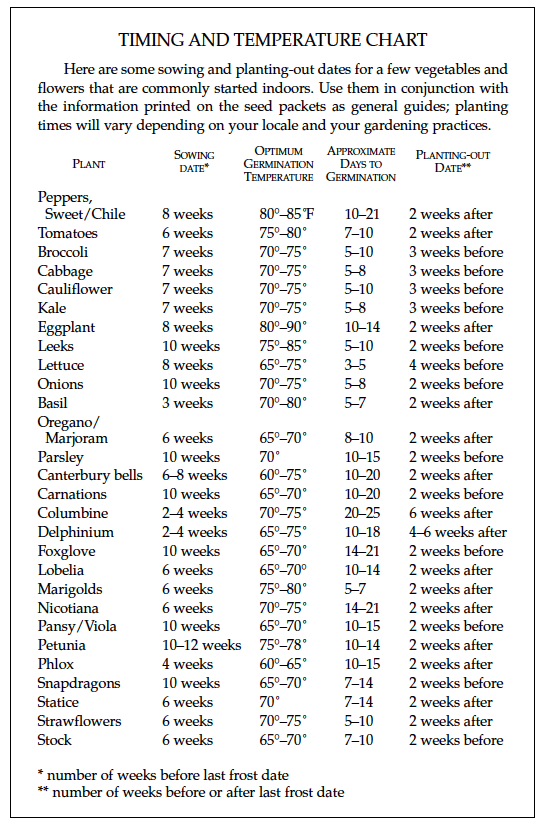
Many commonly grown vegetables and annual flowers are native to tropical or subtropical regions of the world, and their seeds are genetically programmed to germinate only in warm soil. Such seeds germinate better if their soil (not air) temperature is constantly 75°F or warmer (see the chart on p. 11 of this bulletin and the seed packets for optimum temperature ranges). Keep your seed trays constantly warm by placing them on top of a water heater or refrigerator or above a floor register. Another way to keep seed trays warm is to place them under fluorescent lights (see "Light" on p. 6). Do not put seed-starting trays on a windowsill. Temperatures near a window (especially at night) are almost always too cool for good germination. Consistently warm temperatures, both day and night, signal the seeds to sprout. If you don't have a place where your seed trays will receive even warmth, you may want to buy an electric seed propagation mat (Shepherd's offers an excellent one). You can also make your own out of heating cable (available at many garden centers). Not all seeds require extra warmth to germinate. Seeds of plants native to temperate climates generally sprout well at cooler temperatures. Read the seed packets carefully. If no temperature is specified, room temperature is fine.
MOISTURE
Seeds also need to be kept constantly moist in order to germinate. Two key words here: constantly and moist. Never let the growing mix dry out. On the other hand, you don't want the mix to be too wet; the consistency of a wrung-out sponge is about right. Moisten the growing mix thoroughly before you sow your seeds by placing it in a tub and slowly adding water. Stir the mix with your hand to distribute the moisture evenly. After you sow your seeds, drape a sheet of plastic wrap over the container to slow evaporation. (Don't attach the plastic to the container; you want at least some air to reach the growing mix.) Be sure to check every single day for signs of germination. As soon as you see a sprout, remove the plastic wrap to allow air to circulate around the emerging seedlings. Check your seed-starting containers daily and water as needed to keep the surface of the growing mix evenly moist, but don't pour water in the container, or your unrooted seeds will wash right out. Use a plastic spray bottle or a watering can with a very fine, upward-pointing rose so the drops fall very lightly on the growing mix. If you are using an electric propagation mat, be sure the water reaches the bottom of the container (the growing mix in containers sitting above a heating mat can dry out from the bottom up). Poke your finger all the way to the bottom to check that the growing mix is moist all the way through. The water you use should be room temperature or warmer. If chlorinated water comes out of your tap, let it sit for a day before you use it so the chlorine will have a chance to dissipate.
LIGHT
Most seeds don't need light to germinate. They prefer a womb-like environment: warm, moist and dark. But as soon as a seedling appears above the growing mix, light is an absolute necessity.
FERTILIZER
Seeds don't require fertilizer to germinate. They have enough food inside them to sprout on their own. Young seedlings, on the other hand, need regular doses of a weak fertilizer solution to grow successfully.
SOWING YOUR SEEDS
Now that you understand the five basic conditions necessary for germinating seeds, it's time to sow them. In addition to containers and growing mix, you'll need plant labels and a pen with indelible ink to write the plant name and the date sowed. You can use clean Popsicle sticks, strips of stiff plastic or labels designed for just this purpose (Shepherd's sells traditional wooden ones). Don't skip this step. If you neglect to label your containers, you'll quickly lose track of which seeds are which and the date you sowed them.
One last critical thing: timing. Most gardeners time their sowings according to the average date of the last spring frost in their area. (If you don't know your last frost date, consult fellow gardeners, your local garden center or the Master Gardeners at the Cooperative Extension Service--see the government pages of your phone book under county offices or under the state department of education or of agriculture.) Depending on the flower or vegetable variety, you should sow your seeds anywhere from two to ten weeks before that date. The chart on p. 11 lists sowing and planting out dates for many common vegetables, flowers and herbs. Shepherd's seed packets also provide this information--be sure to read them! Sowing your seeds at the proper time indoors allows them to grow into robust seedlings that will be ready for planting in the garden when weather conditions are right in spring.
Sowing seeds is easy. Begin by filling your containers almost to their brims with moistened growing mix. Tamp it down gently and smooth it out. Sow the seeds as directed on the Shepherd's seed packets. To keep track of where you have put your seeds, you may want to set them on the surface of the growing mix and then sift extra mix on top to cover them. If you are sowing tiny flower seeds, simply press them into the surface and then cover the container loosely with a sheet of clear plastic wrap.
If you're using individual containers, you'll want to put only a couple of seeds (the extras are for insurance) in each container. In flats, space your seeds 1/2 in. apart if you intend to transplant them to individual containers after they sprout, or 1-2 in. apart if you're going to keep them in the same flat until planting-out time. It's always best to sow more seeds than you think you'll need. They may not all germinate, and you want to have plenty of seedlings so you can thin out the smallest and weakest ones (see "Growing to Planting-out Size" on p. 8). If you sow more than one type of seed in a tray or flat, pair up varieties that have about the same germination time and planting-out date. Read the seed packets carefully to find an appropriate match. Don't forget to label each variety as you sow the seeds.
It's time now to set your trays in that warm spot you picked out and to make absolutely sure you keep them evenly and consistently moist. Check them every single day. The minute pale stems start to push through the growing mix, rejoice! You've started the miraculous cycle of growth.
HOW TO GROW SEEDLINGS LIGHT
We started the list of seed-sowing requirements with soil, but we're going to change the order here, because the very first thing you need to do for those sprouted seeds is to give them light. Lots of it. Otherwise, you'll end up with leggy, pale, weak seedlings that will never grow into robust plants. Even if they make it to their planting-out date, they won't have much of a chance of surviving in the garden.
Some people manage to grow healthy seedlings on a windowsill, but in most houses, seedlings don't get enough light in a window, no matter which direction the window faces. If you are determined to try, be sure to rotate the plants every day (they'll grow toward the window), and put aluminum foil reflectors behind and around the sides of your containers to bounce more light onto the plants. Avoid windowsills where the temperature drops drastically at night.
For most of us, the best way to give seedlings the light they need is to grow them under fluorescent fixtures. Don't use incandescent light--90% of it is lost to heat, and it doesn't have the right spectrum for plants anyway. Use a pair of standard 4- to 6-ft. fluorescent shop lights. You don't need special grow lights; regular cool-white fluorescent tubes are fine for growing seedlings.
Fluorescent lights may appear bright on a cloudy winter day, but the light they throw is nowhere near as intense as the sun. To be effective, they must be suspended just above the plants--no more than 1-2 in. above-- and they must be on 16 to 18 hours a day. As your seedlings grow, you'll need to raise the lights. You can build a wooden stand or you can simply screw cup hooks into a shelf in the closet and hang the light fixtures from chains. (The chains make adjusting the height of the lights easy.) Shepherd's also sells a number of different Grow-Light units, one of which is sure to be right for your seedstarting needs.
Remember, light--whether natural or artificial--is critical to the health of your seedlings. If they don't get enough, they'll grow up weak and spindly, with long stems, few leaves, and a poor shot at thriving in your garden.
MOISTURE
As I said before, it's important to keep seeds constantly moist after you sow them to encourage germination, but seedlings require less moisture. Begin watering them slightly less often. Once they are a few inches tall, it's okay to let the top half-inch or so of growing mix dry out between waterings. Check daily by putting your index finger into the mix. The finger test is the best way to see how moist the growing mix is; it's hard to tell by looking, even for experienced gardeners.
Too much moisture encourages root rot or "damping off," the infamous fungus that can fell seedlings overnight. Water seedlings a little less frequently (but more deeply) than you did before they germinated. Use the finger test to see if water has penetrated deeply enough. You can also discourage the damping-off fungus by making sure air can circulate around your plants. Elevate your containers a few inches above the tabletop and allow space between the containers for air movement.
If the damping-off fungus does strike, you'll know: whole flats of young seedlings will suddenly and mysteriously keel over at the soil line and die. Throw out the infected seedlings--every one of them. Then make sure the survivors get plenty of ventilation but not too much water. Don't reuse growing mix that held infected plants, and sanitize containers with a weak (9 to 1) bleach solution and allow them to air dry before using them again. To prevent a recurrence of the fungus, put a 1/4-in. layer of sand or vermiculite on top of your growing mix before you sow seeds to promote drainage at the base of the seedlings' stems, and mist seedlings on occasion with chamomile tea, which seems to inhibit the growth of the fungus.
TEMPERATURE
Heat-lovers such as tomatoes, peppers and eggplants require warm temperatures (70-75°F) after germination to grow well. Most other plants prefer somewhat cooler temperatures once they are up. (Cabbages and their kin, for example, will get leggy and weak-stemmed if grown too warm.) Take all but the heat-lovers off the propagation mat (if you're using one) once they have two sets of leaves.
FERTILIZER
Seeds don't need fertilizer while germinating. Seedlings, on the other hand, rely on you to provide them with the nutrients they need to grow. Start giving them water-soluble fertilizer, mixed at just half the strength recommended by the manufacturer, when they produce their second set of leaves. Feed your seedlings every ten days or so. Any all-purpose fertilizer, such as Rapid Grow, Miracle Gro or Peters, works fine. If you prefer an organic fertilizer, try Shepherd's Vitalize, or fish emulsion from the garden center (but be warned that they are a little odoriferous).
Proper fertilization is crucial. I know because I've made mistakes at both extremes. In my early ignorance, I didn't fertilize at all--and wondered why my seedlings always started out well and ended up puny and off-color. Then, to compensate, I overfertilized, dumping a whole gallon of fishy water on two flats of plants. The leaves got white spots and were about ready to expire when someone tipped me off to my mistake. The point is that you can give your seedlings too much of a good thing. Moderation works!
GROWING TO PLANTING-OUT SIZE
It's important to thin your seedlings, keeping only the best specimens. Use a small pair of scissors to snip off weak or unwanted seedlings at soil level. Don't yank them out; you'll disturb the roots of the plants you want to keep. It's hard for novice seed starters to discard seedlings they have nurtured so carefully, but please do learn to do it. Overcrowded seedlings always develop into inferior plants that are unlikely to succeed in the garden. Their roots become intertwined and crowded, so you can't separate individual plants; they are much weaker and more disease-prone than well-spaced seedlings; and without the room they need to grow properly, they end up with leggy stems and sad, pale leaves. Save yourself a lot of grief by thinning seedlings or spacing them out as soon as they have a set of "true" leaves (see below).
As I mentioned earlier, many growers prick out young seedlings--that is, transplant them to wider spacing in new flats or put them in individual containers as soon as they have developed their first "true" leaves (the first pair of leaves that appear are the "seed" leaves). This method allows you to start a lot of seeds in a relatively small container (space is at a premium under the lights). When the seedlings have a set of true leaves, you transplant the best of them into proper quarters, and toss the rest out or pass them on to friends. There is a little more work involved, but the reward is a more vigorous crop of seedlings. You'll need one container for seed-starting and another, deeper one (or 4-in. pots) for growing seedlings on to planting-out size.
To prick out seedlings, slice a section of seedlings out of the tray and set them on a damp cloth. Cover the roots with the cloth to prevent them from drying out. Using your finger or a pencil, make a hole in the growing mix in the transplant container. Then, with a butter knife or fork, carefully work one seedling free. (Separate entangled roots by gently shaking a small cluster of seedlings.) Pick the seedling up by its seed leaves (not its true leaves, not its stem, not its roots--you don't want to risk damaging any of these parts) and set it in the hole, burying the stem right up to the seed leaves. Firm the growing mix gently and water carefully but thoroughly to settle the seedling into its new home. Space seedlings 2-3 in. apart. If they start to wilt right after transplanting, resist the temptation to water them again. Put them back under the lights, and they will perk up in a day or two.
Note: If you're growing flowers from a mixture, keep as many seedlings as possible to ensure that you get plants that will bloom in the full range of colors. Plants in a mixture may grow at different rates, so make a point of keeping seedlings with a range of different sizes.
If you keep your seedlings in the same container all the way to the planting-out stage, thin them when they have their first set of true leaves, allowing 3 in. between seedlings to prevent overcrowding.
HARDENING OFF & PLANTING OUT
Given the tender loving care they require, your seedlings will soon grow vigorous and lush, and with luck, the weather will have warmed when the time comes to transplant them to their final home in your garden. But before you reach for your trowel, you must acclimate your seedlings, which have never known a stiff breeze or the glaring midday sun, to life outdoors--a process called "hardening off." When the weather is warm and settled both day and night (see seed packets for specific recommendations), set your seedlings, still in their containers, outdoors in a lightly shaded, sheltered spot. Keep the seedlings well-watered and protect them from strong winds as you gradually increase their exposure to direct sun. Begin with just a few hours of morning sun the first day or two, then give the seedlings a half day of sun and finally several full days of sun. Begin leaving them outdoors through the night about half way through the hardening-off process. If you work during the day, set your seedlings outdoors for a few hours on Saturday and Sunday morning. Then leave them out all day, increasing the amount of sun they receive by shifting them gradually day by day from an eastern to a western and finally to a southern exposure.
After you have hardened off your seedlings, it's time for the most satisfying part of seed-starting: planting your seedlings in the garden. To make the adjustment as easy as possible, plant them out late in the afternoon or on an overcast day. Then make sure they are neither too moist nor too dry and dig them carefully from their flats. Try not to handle the root balls, as the roots are quite fragile. Pick the seedlings up very gently by their stems, trying to keep the soil around the roots as intact as possible. Keep roots covered and don't expose them to the air any more than necessary. Set each plant in a prepared hole up to its first pair of true leaves, tamp the soil firmly around it, then water thoroughly, even if rain threatens, to get rid of air pockets and ensure good root-to-earth contact.
The final transfer of your carefully nurtured seedlings out to the real world is always a very rewarding act--a moment of real accomplishment and pride. Enjoy it. You've earned it!
Pat Stone is former Garden Editor of Mother Earth News and Back Home magazines and was Book Editor of Simon & Schuster's The Healthy Garden Handbook. When many of our customers asked for more advice on starting seeds than we could fit in our catalog, we remembered Pat's ability to explain gardening topics in a clear, informative style and asked him to write this seed-starting bulletin. Pat is currently the editor of GreenPrints, the only magazine that explores the human rather than the how-to side of gardening. If you'd like to know more about his unique and entertaining journal, we invite you to write to GreenPrints, P.O. Box 1355, Fairview, NC 28730, or visit the Web site, www.greenprints.com.