How to Grow Orchids
The key to growing Orchids as houseplants is to check them at least once a week to make sure that you are meeting their requirements for light, water, humidity, and room temperature. Please read the specific information about the Orchid you have received, as well as the general information on Orchid culture found below. If you have a question that this page does not answer, please call our Garden Advisors at 1(800) 411-6159 from 9 to 5:00 EST, Monday through Friday, or visit the American Orchid Society at www.aos.org.
Orchid Care
How to Water Orchids
Watering houseplants is always a balance between too much water (which causes rot and eventually kills) and not enough water (which causes leaves, stems, and roots to dry up and eventually kills). Water your Orchid thoroughly with tepid water when the potting medium feels dry 1 inch below the surface, usually about once a week. Lift the nursery pot from its basket or cachepot and carry it to the sink. Water until the excess runs out of the bottom of the pot. Allow the pot to drain, then return it to the container. Do not allow water to pool in the bottom of the container. If the nursery pot sits in water, the plant's roots will eventually rot.
Keep in mind that your Orchid's need for water will vary throughout the year depending on its surroundings. The need for water increases when the plant is exposed to brighter light, higher room temperatures, or lower humidity, or when it is producing new shoots, leaves, and roots (but not when it is blooming). Some Orchids have pseudobulbs (upright, thickened stems that store water and food). If the pseudobulbs begin to shrink, this means that they are losing water and you have kept your plant too dry.
Humidity
Most Orchids are native to tropical or subtropical regions of the world, where relative humidity is typically very high. They suffer indoors in the dry air produced by furnaces and woodstoves. A relative humidity of 70% is best for most Orchids (provide a relative humidity of 40-50% for Paphiopedilums). You may increase the humidity around plants by running a humidifier nearby. You can also set plants in trays filled with pebbles or gravel. Add water to a level just below the tops of the pebbles (if the potting medium in the pots comes in contact with the water, it will draw water into the pot, which will cause the medium to become saturated, eventually leading to rot). Refill trays frequently to replace water lost through evaporation. Please note: although high humidity is important for Orchids, good air circulation around your plant is also essential to prevent disease.
Fertilizer
Orchids do not require heavy fertilizing. Apply a weak solution of our Grow Fertilizer (18-18-18) weekly, diluted to ¼ strength. Use a narrow spouted watering can to slowly pour the fertilizer into the pot, avoiding the leaves. Each month, water with plain water to flush out any accumulated fertilizer salts. Switch to our All Bloom Fertilizer (15-30-15) in the fall, when many Orchids are initiating flower buds.
Flowering
The Orchids we ship have buds fully visible and will generally bloom within weeks of arrival. Do not remove the flower shoot until it is completely desiccated and lifeless; flower stems that appear to have finished producing blooms may send out more flowering shoots months or even years later. An adequate amount of light (but never direct sunlight) is important for Orchids to grow and produce flowers. A change in temperature between day and night is also necessary for flowering -- usually a difference of 10-20°F.
Grooming
After bloom, remove spent flowers with a pair of scissors, cutting the flowers off where they attach to the flower stem.
How to Repot an Orchid
Repot your Orchid every other year or so. After it blooms, remove the plant from the pot and gently shake the old bark from the roots. If you find dead roots (brown or dried out), either pinch them off with your fingers or cut them off with a sharp knife. Repot in a container no more than 1 inch larger than the previous one, using a medium bark designed especially for Orchids. Hold the stem in the center of the pot and fill the pot with premoistened bark, pressing it firmly around the roots with your fingers. The crown of the plant - the point where the stems meet the roots - should be level with or just below the surface of the bark. For Moth Orchids, the lowest leaf should just touch the surface of the bark. Water thoroughly after potting to settle the bark around the roots. If the plant is unable to hold itself upright, support with a bamboo stake and plant clip or twist tie. Please note: Many Orchids produce fleshy, wormlike roots that have a tendency to push their way up through the surface of the bark. This is perfectly normal. There is no need to cover these roots with bark.
Types of Orchids
Beallara — Beallaras prefer intermediate growing conditions (70-85°F during the day; 55-60°F at night). Provide bright light but no direct sun. An east window is ideal, but they also thrive in south- or west-facing windows that are shaded with sheer curtains or blinds. During the growing season (spring, summer, and fall), water freely when the potting medium feels dry 1″ below the surface. In winter, your plant should be kept drier.
Brassidium — This is a hybrid that enjoys a lot of indirect light and daytime temperatures of 70–85°F. Sunday Best 'Muffin' combines the features of three Orchid genera (Brassia, Miltonia, and Oncidium) and is easy to grow in very bright but indirect light and temperatures of 70–85°F during the day.
Cattleya — These Orchids prefer intermediate growing conditions (70-80°F during the day; 60-65°F at night). Place your plant where it will receive very bright, indirect light. A spot near a south-facing window that is shaded with sheer curtains or blinds is ideal. The resting period (when no new leaves, roots, or shoots appear) is from fall through mid-spring, although this is the time when flowering occurs. In summer, fertilize as recommended below.
Colmanara — Easy to grow as houseplants, Colmanaras thrive in intermediate to warm growing conditions (65-85°F during the day; 55-68°F at night). They grow well in bright but indirect light. During the growing season (spring, summer, fall), water when potting medium feels dry 1" below the surface. Provide good air circulation.
Cymbidium — Known as the "King of Orchids," Cymbidiums have long, leathery leaves and large flowers. These Orchids prefer cool to intermediate growing conditions (65-80°F during the day; 45-55°F at night). Provide bright indirect light. A spot near a south-facing window is ideal. In late fall and winter, when the plants are resting (but do produce their blooms), water sparingly. Provide good air circulation around your plant as well.
Dendrobium — These Orchids prefer intermediate to warm growing conditions (75-85°F during the day; 55-65°F at night). Provide very bright light but no direct sun. An east window is ideal, but they also thrive in south- or west-facing windows that are shaded with sheer curtains or blinds. The growing season is from spring to summer; plants rest in winter. These Orchids flower best when grown in small containers; they prefer to be crowded.
Laeliocattleya — These Orchids prefer intermediate growing conditions (70-80°F during the day; 60-65°F at night). Place them where they will receive very bright, indirect light. A spot near a south-facing window that is shaded with sheer curtains or blinds is ideal. Their resting period (when no new leaves, roots, or shoots appear) is from fall through mid-spring, although this is the time that flowering occurs.
Miltassia — This is a hybrid between the Orchid genera Brassia and Miltonia and enjoys bright but indirect light and daytime temperatures of 70–85°F.
Miltoniopsis (Pansy Orchids) — Pansy Orchids prefer cool to intermediate temperatures (70-80°F during the day; 50-60°F at night). Provide bright light but no direct sun, which can burn the leaves. If the leaves' color begins to change from a vibrant spring green to a pale green, your plant may be receiving too much light. If the leaves turn yellow, the plants are receiving too much water (which may cause rot and death). Take care to keep your plant evenly watered as the leaves will begin to fold or "accordion" if the supply of moisture is not consistent. Once the leaves change shape, they will not flatten out again. In hot areas of the country, it will help to mist your plant in the morning on the days you do not water it. Plants flower in the spring with occasional rebloom in the fall.
Oncidium — Oncidiums prefer cool to intermediate growing conditions (65-80°F during the day; 45-55°F at night). Provide very bright, indirect light. A spot near a south-facing window is ideal. During the growing season (spring, summer, and fall), water freely. In winter, your plant should be kept drier, but not so dry that the pseudobulbs (upright, thickened stems that store water and food) begin to wither. If the pseudobulbs begin to shrink, this means that they are losing water and you have kept your plant too dry.
Paphiopedilum (Tropical Lady's Slipper Orchids) — These Orchids thrive in bright but indirect light. An east-facing window is ideal, but plants can also grow well in a south- or west-facing window if shaded somewhat by neighboring plants or a sheer curtain. If the leaves begin to bleach to a pale green or yellow green color, then your plant is receiving too much light. The Paphiopedilums we offer need warm temperatures (75-85°F or more) during the day and cool temperatures (60-65°F) at night to set their flower buds. They also prefer a moderate relative humidity -- between 40-50%. Do not mist Lady's Slipper Orchids because misting may cause the growing point, where new leaves are produced, to rot. For optimum growth and flowering, fertilize with a high-nitrogen, water-soluble fertilizer (30-10-10) mixed at 1/4-strength once a month in fall and winter, and at 1/2-strength every 2-3 weeks in spring and summer. Flush with clear water monthly to leach excess fertilizer from the growing medium. Blooms generally appear in late winter. Remove spent flower stems just above the foliage and cut off old, brown leaves.
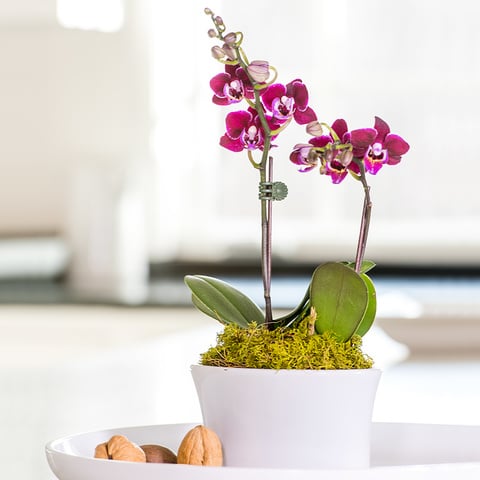
Phalaenopsis (Moth Orchids) — These are excellent houseplants, producing spikes of spectacular blooms in winter or spring that last for months. Phalaenopsis prefer intermediate to warm growing conditions (70-80°F during the day; 60-65°F at night). Provide bright light but no direct sun. An east window is ideal, but they also thrive in south- or west-facing windows that are shaded with sheer curtains or blinds. The growing season extends from April to October. Please note the special repotting for this type of Orchid in How to Repot an Orchid, above. Do not mist a Moth Orchid because misting may cause the growing point, where new leaves are produced, to rot.
Vanda — Vandas produce colorful dappled blossoms. They prefer intermediate to warm growing conditions (63-80°F). Provide bright light but no direct sun. A spot in an east-facing window is ideal, but they also thrive in south- or west-facing windows that are shaded with sheer curtains. Our Vandas are shipped with an acrylic vase. To water, fill the vase halfway with room temperature water. Wait about 30 minutes and empty the water from the vase. Water twice a week or up to 3 times if grown in dryer conditions.
Zygopetalum — These Orchids grow best in daytime temperatures of 70–80°F, with a drop to 55–60°F at night. Provide plenty of bright light but no direct sun, and keep the potting medium slightly moist but not wet.