
Planting and Growing Bearded Iris
These brilliantly colored, spring-flowering perennials are part of a huge plant family that contains upwards of 300 species which are native to Europe, Africa, Asia, and North America. Iris range from timid and inconspicuous wildlings to the splendid and extravagant Tall Bearded Iris, which create striking vertical highlights in the late spring border. The chosen habitats of Iris range from standing water to formal borders, and there is scarcely a color or combination of colors that can't be found. Iris plants are fairly indestructible. They thrive in most parts of the country and are largely critter resistant. Adding to their appeal, they are attractive to hummingbirds and other pollinators. Even after bloom, the vertical foliage persists through the growing season. Plant a variety and enjoy a rainbow of colors that will return year after year in your garden. Please note that Bearded Irises may not bloom the first year after planting.
Light/Watering: Full sun and well-drained soil are important for vigorous growth and flowering. Be careful not to overwater, as too much moisture in the soil can cause the rhizomes (roots) to rot. Check the soil with your finger; the soil should be dry to 1" deep before watering again. Be sure to water deeply during summer drought. Consistent watering is especially important for reblooming Irises.
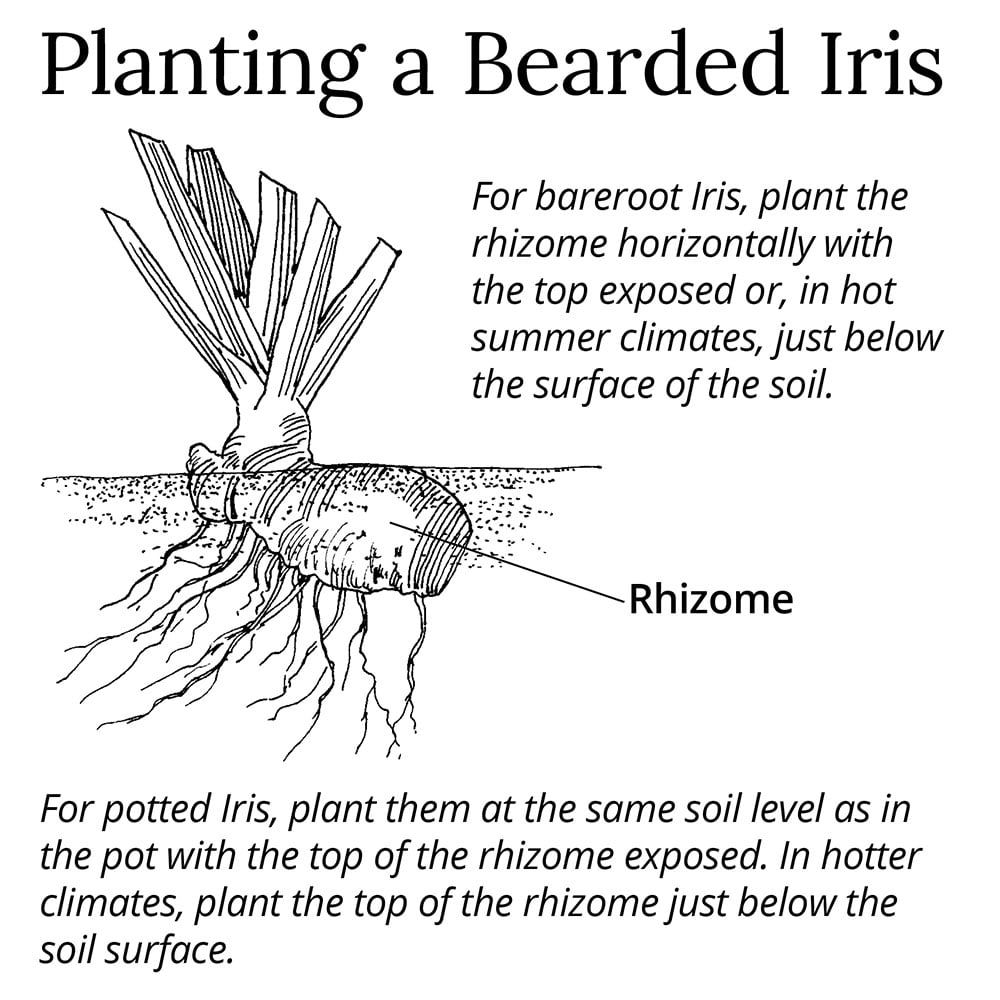
Fertilizer/Soil and pH: Iris will not tolerate soils that are wet in winter. Good drainage is important all year, and a pH near neutral (6.8) is preferred. In climates with very hot summers, plant the rhizome just below the soil surface; in cooler climates, the top of the rhizome should be exposed. Do not mulch around the rhizome as this practice may encourage rot. Fertilize in early spring with an all-purpose fertilizer scratched in around the plants, avoiding direct contact with the rhizome. Reblooming Irises perform best if fertilized again after the first wave of flowering is finished.
Pests/Diseases: The Iris borer, the worst pest of these lovely plants, overwinters as eggs in spent leaves. The borers emerge in the spring as tiny caterpillars which spend a couple of weeks boring through the leaves down into the rhizome. It's possible to kill the borers, if you catch them early enough in spring, by handpicking or with Bt (a naturally occurring soil organism that will kill the caterpillars but not your plants); otherwise, they will chew on the roots from spring until August. One of the first signs you’ll see is streaks of discoloration in the leaves. You may see that the center foliage is the most damaged, with notched edges in the leaves, and you may even see slimy frass (excrement). The borers create channels and migrate down into the rhizome where they can cause susceptibility to a bacterial disease known as soft rot (or root rot). The rhizome will become mushy and hollow and have a foul odor and should be discarded. If small areas of the rhizome are affected with root rot, cut away those areas and let the wound dry in the sun. We recommend applying a chlorine-based powdered cleanser to the wound and then replant. Unless the infestation is severe, plants usually recover. Garden sanitation and fall clean-up of old leaf debris is important to remove any eggs laid so they can’t overwinter and hatch in the spring.
Companions: Irises are best planted in groups, surrounded – but not crowded – by other perennials. They are lovely blooming with Lilies, Herbaceous Peonies, Roses, and Oriental Poppies. Perennials will conceal spent Iris foliage in summer. Make sure to leave room between plants to provide for good air circulation.
Reflowering: The buds on Tall Bearded Iris are spaced at intervals along the stems, and they flower sequentially. Remove spent blooms consistently. After flowering has subsided, cut the flower stalks at the base and remove them.
Reblooming: Reblooming varieties may produce new flower spikes 4-8 weeks after the first flush of blooms. Please keep in mind that rebloom may not occur in regions colder than zone 5. To encourage rebloom:
Dividing/Transplanting: Divide your Iris when the clump becomes crowded and bloom diminishes, usually every 3 to 4 years. (Reblooming varieties may need to be divided more frequently, every 2 to 3 years.) The timing of division is very different from that of most perennials. Bearded Iris go dormant shortly after flowering, which makes summer the ideal time to dig up the rhizomes. Even though reblooming Irises don't go dormant, this is also the correct time to divide those varieties. Break the rhizomes into pieces or cut them with a sharp knife. Select divisions with healthy fans of leaves, most likely from the outermost part of the plant. Discard the crowded interior pieces and any that show signs of soft rot; dispose of these in the trash, not in the compost. Trim the leaves back to about 6" in height. Some gardeners like to dust the cut surfaces with powdered sulfur while others dunk rhizomes in a solution of 1 part bleach to 10 parts water. We haven't found this step necessary, but it might be advisable if you have had problems with rot. Replant promptly. You will probably find yourself with extra divisions you can share with friends.
End-of-Season Care: After hard frost in the fall, cut foliage back hard removing any foliage that appears spotted or yellowed and dispose of all infected debris in the trash; do not compost. We recommend winter protection in cold climates, especially for the first winter after planting. We suggest covering the rhizomes with evergreen boughs or straw, applied after the ground freezes.
Calendar of Care
Early Spring: Remove and destroy any old foliage to allow for fresh, new growth and prevent Iris borers from emerging as the weather warms. Remove any winter mulch, at the time you see Forsythias blooming, to prevent moisture retention around the roots. Feed plants with an all-purpose fertilizer scratched in around the plants, avoiding direct contact with the rhizome.
Mid-Spring: Watch for the telltale signs of Iris borers in the foliage--dark vertical lines that may appear watery show up in the leaves--and destroy any visible caterpillars. If infestation is severe, remove affected foliage completely and destroy.
Late Spring: Taller forms may need staking. Deadhead as flowers fade and cut entire flower stalks down at the base when blooming is finished. Fertilize reblooming varieties again after the first wave of flowering is through.
Summer: If plants need dividing, complete this task after flowering finishes. Water divisions well during dry periods. Trim the foliage back to 6" cutting the leaves on an angle, creating a fan shape.
Fall/End of Season: After hard frost in the fall, cut foliage back hard removing any foliage that appears spotted or yellowed, and dispose of all debris in the trash. You may choose to keep healthy leaves as the foliage of most Irises will persist through winter. Keep in mind, there may be borer eggs that you are not seeing so you might not want to take a chance of encouraging pests. Winter protection in cold climates is recommended, especially for the first winter after planting. After the ground freezes, cover the rhizomes with a light layer of evergreen boughs or straw.