Product Details
Bright red Amaryllis 'Samba' introduces an exciting new look with its wide, pure white edging and flares on 6" lightly ruffled flowers. Each bareroot bulb arrives in a reusable linen bag, ideal for gifting.
The shapely blooms and rich, iridescent colors of Amaryllis (Hippeastrum) light up a day like nothing else we know. Shipped directly to us from growers in the Netherlands, our premium-grade bulbs are, with few exceptions, the largest commercially available. They require only warm temperatures, attention to watering, and bright light to deliver a truly spectacular performance – a process that is great fun to watch.
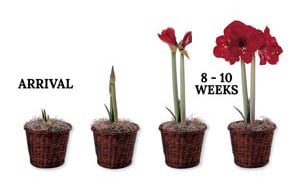
Please allow 8–10 weeks from receipt for Amaryllis bulbs to bloom. Our bulbs are guaranteed to produce two flower stems, most with four blossoms apiece.
While our Amaryllis bulbs come from the Netherlands and South Africa, the 100 or more species of Amaryllis in the genus Hippeastrum are native to Central and South America, where they grow in tropical, subtropical, and temperate environments. These bulbous perennials (not to be confused with the genus Amaryllis, otherwise called Naked Ladies or Jersey Lilies, native to South Africa) send forth fleshy, strap-shaped leaves and sturdy stems that bear multiple trumpet-like blossoms. In the Northern Hemisphere, large-flowering Amaryllis hybrids are grown indoors to brighten up living spaces. Colorful and carefree, they make a fabulous gift for anyone on your list, gardener or otherwise. Although many devotees grow new bulbs each year, existing plants will, with proper care, rebloom year after year. Amaryllis also make beautiful garden plants during the growing season.
For more information on Amaryllis care, click Growing Guide.
Shipping
Shipping
HOW PLANTS ARE SHIPPED
The size of the plants we ship has been selected to reduce the shock of transplanting. For some, this means a large, bareroot crown. Others cannot travel bareroot or transplant best if grown in containers. We ship these perennials and annuals in 1 pint pots, except as noted. We must point out that many perennials will not bloom the first year after planting, but will the following year, amply rewarding your patience. We ship bulbs as dormant, bare bulbs, sometimes with some wood shavings or moss. Shrubs, Roses, vines, and other woody plants may be shipped bareroot or in pots. The size of the pot is noted in the quick facts for each item.
WHEN WE SHIP
We ship our bulbs and plants at the right time for planting in your area, except as noted, with orders dispatched on a first-come, first-served basis by climate zone. We also ship a wide range of containers and planters, tools, supplies, fertilizers, garden wear, garden decor items, as well as indoor decorations like wreaths and dried bouquets when available. Estimated dates for shipping are indicated in the green Shipping Details box for each item. Please supply a street address for delivery. Kindly contact us with two weeks notice, if you'll be away at the expected time of delivery.
OUR GUARANTEE
We guarantee to ship plants that are in prime condition for growing. If your order is damaged or fails to meet your expectations, we will cheerfully replace or refund it. Please contact our Customer Service Department at 1-800-503-9624 or email us at [email protected]. Please include your order number or customer number when contacting us.
Reviews
Reviews
There are no reviews yet. Be first to Write a Review.
Growing guide
Growing guide
Print Grow Guide
How to Grow Amaryllis
Amaryllis bulbs are prized for their easy care and remarkable floral display. Conditioned to bloom early, potted Amaryllis flowers brighten our interiors on short winter days and if started later are easily enticed to bloom in spring. Generally, Amaryllis bulbs will flower 8-10 weeks when planted in the winter, and 6-10 weeks when planted in the warmer spring months. These naturally spring-blooming plants, which are native to arid regions of Central and South America, can also be grown in the ground or in outdoor containers, making great patio plants. Amaryllis are perennial in Zones 8-11 and can be grown outdoors in cooler-climate gardens as well, either treated as annuals for one season or lifted in fall for frost-free winter storage and replanted the following year.
GROWING AMARYLLIS OUTDOORS
- Amaryllis bulbs can be planted directly in the ground in Zones 8-11, where they will be perennials and increase over time. Some Zone 7 gardeners overwinter them in the ground, in carefully chosen warm microclimates (with thick winter mulch), but success where temperatures dip below 20° F is not guaranteed.
- In colder climates, zones 6 and below, Amaryllis make lovely and surprising garden accents when planted outdoors (in the ground or in containers) and can be treated as you would Dahlias. The bulbs can be potted early for display once the temperature has warmed or to be transplanted directly in the soil when it warms to 60° F.
- These naturally spring-blooming bulbs sometimes break dormancy during storage and start growing on their own. To keep them until potting or planting time, store in a cool, dry and dark place. To keep bulbs dormant as long as possible, we store them in a 38-40° cooler. A regular refrigerator is too cold, so find the coolest spot you can, but check on them occasionally and pot them up if they start growing.
- When planted outdoors in spring, plants are likely to bloom at a shorter height but will regain stature in subsequent years.
- Choose a site with full sun (at least 6-8 hours of direct sun daily). In extremely hot areas, some afternoon shade is beneficial.
- Amaryllis demand well-drained soil. Bulbs are likely to rot in heavy soil or places where water collects, especially during winter dormancy.
- In frost-free areas, plant bulbs with the neck and shoulders slightly above ground level. In colder areas, cover bulbs with 4-6” of soil and plan to mulch well in fall, for winter protection. Bulbs can be planted 12-15” apart.
- Water the area well after planting, then wait until growth begins, as dormant plants cannot take up much water. Once growth starts, water only during prolonged dry periods.
- After the leaves appear, fertilize with a balanced fertilizer (such as 10-10-10) during the growing season, according to directions on the package.
- When plants are done blooming, cut off just the flower stalks, leaving an inch or two, with a sharp knife or pruners. Be sure to leave the foliage on the plant so the leaves can produce food that will be stored in the bulbs. Just as with daffodils or other bulbs, the leaves collect energy from the sun to replenish the bulbs so they will be able to bloom again the following year.
- In fall, leaves may turn yellow, as days shorten and temperatures cool, prompting plants to go into their winter dormancy. They can be removed. The dry, cool dormant period is what sets the flower buds. In cold climates, once leaves yellow or frost threatens, gently dig up the bulbs, cut off foliage and store them in a cool, dry, dark place for at least 2 months. If you are growing them in containers, they can be stored still planted in their pots.
- Amaryllis shipped in bags require potting. Begin by selecting a pot for your bulbs. If planting individually, choose a 6-7" pot. If planting a group of 3 bulbs, choose a 10-12" container.
- Place a well-drained potting mix in a plastic tub. Slowly add warm water and stir with your hand until the mix is moist but not soggy. Then fill the pot about half full with potting mix, set the bulb on top of the mix and fill in around the bulb with additional mix. Adjust the position of the bulb as needed, so that the top third of the bulb is exposed.
- The final level of the mix should be about 1/2" below the rim of the pot to allow for watering. Firm the mix and water lightly to settle it around the bulbs. Then follow the "Pre-bloom Care" instructions below.
- Place the pot where the temperature remains above 60°F.
- The warmer the temperature (70-80°F night and day is ideal), the faster the bulb will sprout and grow.
- Providing bottom heat (by setting the pot on a propagation mat or on the top of a refrigerator) may help stimulate growth.
- Water only when the top inch of the potting mix is dry to the touch. Watering more frequently, particularly just after potting, can cause the bulb to rot.
- If the pot is covered with Spanish Moss, lift the moss and pour water directly on the potting mix.
- Growth generally begins in 2-8 weeks. Certain varieties of Amaryllis may take more time to sprout. As long as your bulb remains firm, be patient and take care not to overwater.
- As soon as the bulb sprouts, provide ample sunshine; a south-facing window or a sunroom is ideal.
- Rotate the pot frequently to prevent the flower stalks from leaning toward the light.
- The flower stalks may require support to keep from toppling. Click here for our Amaryllis stakes that are ideally suited to this purpose.
- The best time to cut the flower stems is when the first bud has colored and is just ready to open. This will ensure that the rest of the buds on the same stem have formed sufficiently and will open fully.
- Make a straight cut across the bottom of the stem, so the stem will rest evenly inside the vase.
- Because the stems are hollow, the bottom may split and curl up, but this will not affect the blooms.
- Adding a floral preservative to the water and changing the water regularly will help prevent stem rolling and lengthen the life of your bouquet. Remove individual flowers as they fade.
- If kept at temperatures of 60-70°F, your cut Amaryllis flowers will last for up to 10 days.
- After flowering, your bulb is exhausted. If you want flowers next year (many people prefer simply to purchase new bulbs every fall), you must allow it to rebuild itself.
- When the last bloom fades, cut off the flower stalk 3-5" above the bulb, but do not cut off the leaves. They produce food that will be stored in the bulb.
- Put your plant in a sunny window, preferably one that is south-facing.
- Water when the top inch of the potting mix is dry to the touch, and begin fertilizing with a balanced, water-soluble fertilizer once a month.
- When the danger of frost has passed in spring, set the pot outdoors in full sun or knock the bulb out of its pot and plant it in the ground in a sunny location.
- In fall, before a hard frost, bring the bulb indoors, cut off the foliage just above the bulb, and store it dry in a cool (55°F), dark place such as a basement for 8-10 weeks.
- Then pot (or repot) the bulb and water it. Thereafter, keep the potting mix almost dry until new growth emerges, and follow the instructions under "Pre-bloom Care."
- These large bulbs will grow happily and bloom abundantly in nothing more than stones and water.
- To "plant" your bulb, begin by carefully placing river stones or pebbles to a depth of about 2-4" in our vase or your own container.
- With scissors, trim off any roots on the bulb that are brown and dried*, but let the roots that are whitish and fleshy remain.
- Place the Amaryllis bulb, roots down, on top of the stones, then put the remaining stones around the bulb, leaving the top third of the bulb exposed.
- Finally, add water until the level reaches about 1" below the base of the bulb but no higher. If the base of the bulb sits in water, it will rot.
- After planting, set the container on a sunny windowsill in a room where the temperature remains above 60°F. The warmer the temperature (70-80°F night and day is ideal), the faster the bulb will sprout and grow. Check the water level daily. Add water as needed to keep the level below the base of the bulb.
- A shoot will emerge from the top of the bulb in 2-8 weeks; you may (or may not) see thick white roots pushing between the stones before then. Rotate the container frequently to prevent the flower stalks from leaning toward the light.
- After the last blooms fade, we recommend that you dispose of the bulb; Amaryllis grown in water may not perform well in subsequent years. However, if you do wish to continue growing the bulb, follow the instructions given in "Potting the Bulbs" and "Rebuilding the Bulb."
GROWING AMARYLLIS INDOORS
Pre-potted Bulbs
Amaryllis sent already potted need only to be placed in a warm spot and watered with lukewarm water to begin growing. Then follow the "Pre-bloom Care" instructions below.
Please note: These Amaryllis are shipped with packing material on top of each pot. Carefully remove the packing material around the potted bulb and discard it.
Potting Bareroot Bulbs
Please note: Some of our Amaryllis kits are shipped with a disk of potting medium (Cocopeat). Follow the directions on the package for rehydrating the disk. Fill the pot about 1/2 full with Cocopeat, set the bulb on top, and fill in around the bulb with additional Cocopeat. Adjust the position of the bulb as needed so that the top 1/3 of the bulb is exposed. Do not be concerned if the final level of the Cocopeat is down inside the pot. Firm the Cocopeat and water lightly to settle it around the bulb. Then follow the “Pre-bloom Care” instructions below.
Pre-Bloom Care of Amaryllis
Cutting Amaryllis Stems for Bouquets
Rebuilding the Bulb
Growing Amaryllis in Stones and Water
*We recommend trimming dried roots off because they will decompose in water over time. Adding aquarium charcoal to the river stones will also help prevent any odors.