Product Details
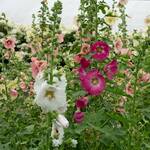
Big, bushy Malva alcea var. fastigiata is a treasure for the midsummer garden, where its soft pink blooms on 3–4′ stems make a handsome display from July–October. The plants form thick crowns from which grow as many as 50 stems, each covered with dozens of small blooms above intricately lobed foliage. This is a plant that can carry a summer border all by itself.
The genus Malva includes 25-80 species (depending on how they’re classified) in the large Malvaceae family. Malvas are related to Cacao, Cotton, Hibiscus, Hollyhocks, and the Linden tree. These somewhat shrubby, herbaceous annual, biennial, or perennial plants are widespread throughout temperate Europe, Africa, and Asia, especially in the Mediterranean region and parts of China and India. They are valued for their medicinal, culinary, and ornamental properties. Most species have alternate, kidney-shaped leaves, sometimes deeply lobed, and showy, 5-petaled flowers that bloom over a long season. They’re easy to grow in average soil where they thrive in heat and humidity. Although short-lived, Malvas replace themselves by freely self-sowing; some species have become naturalized in parts of North America.
For more information on growing Malva, click Growing Guide.
Shipping
HOW PLANTS ARE SHIPPED
The size of the plants we ship has been selected to reduce the shock of transplanting. For some, this means a large, bareroot crown. Others cannot travel bareroot or transplant best if grown in containers. We ship these perennials and annuals in 1 pint pots, except as noted. We must point out that many perennials will not bloom the first year after planting, but will the following year, amply rewarding your patience. We ship bulbs as dormant, bare bulbs, sometimes with some wood shavings or moss. Shrubs, Roses, vines, and other woody plants may be shipped bareroot or in pots. The size of the pot is noted in the quick facts for each item.
WHEN WE SHIP
We ship our bulbs and plants at the right time for planting in your area, except as noted, with orders dispatched on a first-come, first-served basis by climate zone. We also ship a wide range of containers and planters, tools, supplies, fertilizers, garden wear, garden decor items, as well as indoor decorations like wreaths and dried bouquets when available. Estimated dates for shipping are indicated in the green Shipping Details box for each item. Please supply a street address for delivery. Kindly contact us with two weeks notice, if you'll be away at the expected time of delivery.
OUR GUARANTEE
We guarantee to ship plants that are in prime condition for growing. If your order is damaged or fails to meet your expectations, we will cheerfully replace or refund it. Please contact our Customer Service Department at 1-800-503-9624 or email us at [email protected]. Please include your order number or customer number when contacting us.
Reviews
Average Customer Rating:
 (6 Reviews)
Write a Review
(6 Reviews)
Write a Review
Sort by:
Didn’t make it the second time around 
A viewer from Central CT
2 of 2 people found this review helpful. Do you? yes no Certified buyer
Still around 23 years later 
Nancy Long from Chicago, IL
Nice cottagey flower
A viewer from Claverack NY
10 of 10 people found this review helpful. Do you? yes no Certified buyer
It didn't make it. It just died. 
Esther the Gardener from East Leroy, MI
7 of 13 people found this review helpful. Do you? yes no Certified buyer
arrived in excellent condition 
Ann from west of Kentucky, Mississippi River
8 of 10 people found this review helpful. Do you? yes no Certified buyer
Growing guide
Latin Name Pronunciation: mal' vuh
Plants in the genus Malva are somewhat shrubby, herbaceous annual, biennial, or perennial plants widespread throughout temperate Europe, Africa, and Asia. They bloom over a long season, are easy to grow, and tend to be short-lived, but replace themselves by freely self-sowing.
Light: Full sun for best performance; plants produce fewer blooms in part shade
Soil: Well-drained, moderately fertile soil. Plants may grow lanky and need support when grown in overly rich soil.
Watering: Medium watering needs. Although Malvas can withstand drought, they bloom best with sufficient moisture. Water to establish young plants and during dry spells.
Fertilizing: These vigorous plants grow in marginal areas and rarely need fertilizer. Compost should suffice in most soils. Avoid overfertilization.
Seasonal Care: Remove seedpods if you do not want seedlings. Dispose of seedpods responsibly to avoid spreading plants to natural areas.
Pests/Diseases: May develop hollyhock rust toward the end of the summer in humid areas.