Product Details
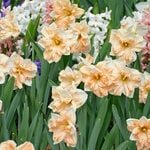
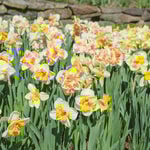
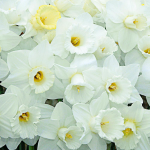
Double Late Tulips make their fashionable entrance into our gardens in May, near the end of the Tulip season, and capture all eyes with their full-petaled, Peony-like blooms. For many years we've suggested that purple-violet 'Blue Diamond' would be a good companion for soft pink 'Angelique' (the Coco Chanel of the Tulip world) or the white, pre-1924 heirloom 'Mount Tacoma,' and here's the proof. Our May Romance Tulip Collection includes 12 of each variety, 36 bulbs total. Labeled. Covers about 8 sq ft.
Tulipa is an enormous genus, consisting of approximately 75 species. Tulips are native to areas including the Middle East and the foothills of the Himalayan mountains. These regions have long cold winters and hot, bone-dry summers, and these are the conditions in which Tulips perennialize (or, in other words, return year after year) most successfully. In North America, it’s difficult, if not impossible, to replicate these climatic conditions, and as a result, we recommend that most Tulips are treated as annuals. Plant the bulbs in fall, enjoy their colorful blossoms in spring, and when the flowers subside, remove the plants, including the bulbs, and compost or discard them. The advantages to this ritual are three-fold: You won’t spend weeks of spring waiting for second- or third-year Tulips that don’t bloom; you won’t spend weeks eyeing yellowing and decaying Tulip foliage in your gardens; and you can look forward to the considerable delight of choosing new varieties, colors, and forms each season to refresh your display.
All that said, there are a few Tulips that are more likely to perennialize than others. Species Tulips, sometimes referred to as “botanical Tulips,” have smaller, somewhat wilder looking flowers than the hybridized goblet forms, but they are more forgiving of milder climates, and they are known to return for two to three years in a favorable site. Long-stemmed, goblet-shaped Darwin hybrids have been bred to offer multi-year performance, and Fosteriana Tulips generally return for up to three years (and sometimes more) under ideal conditions.
Tips for Good Tulip Culture
- In the fall, plant Tulip bulbs in a sunny site with very well-drained soil.
- Plant the bulbs at least 6" deep so they stay insulated through the winter but remain cool as temperatures begin to rise in spring. (Bulbs that are kept cool in spring tend to blossom for a longer period.)
- Treat most Tulips as annuals. Enjoy the flowers in spring, and when they subside, remove the entire plant, including the bulb, and compost or discard.
- Choose Tulip varieties for next spring, and plant them in fall.
For more information on the growing and care of Tulips, click Growing Guide.
Shipping
Shipping
HOW PLANTS ARE SHIPPED
The size of the plants we ship has been selected to reduce the shock of transplanting. For some, this means a large, bareroot crown. Others cannot travel bareroot or transplant best if grown in containers. We ship these perennials and annuals in 1 pint pots, except as noted. We must point out that many perennials will not bloom the first year after planting, but will the following year, amply rewarding your patience. We ship bulbs as dormant, bare bulbs, sometimes with some wood shavings or moss. Shrubs, Roses, vines, and other woody plants may be shipped bareroot or in pots. The size of the pot is noted in the quick facts for each item.
WHEN WE SHIP
We ship our bulbs and plants at the right time for planting in your area, except as noted, with orders dispatched on a first-come, first-served basis by climate zone. We also ship a wide range of containers and planters, tools, supplies, fertilizers, garden wear, garden decor items, as well as indoor decorations like wreaths and dried bouquets when available. Estimated dates for shipping are indicated in the green Shipping Details box for each item. Please supply a street address for delivery. Kindly contact us with two weeks notice, if you'll be away at the expected time of delivery.
OUR GUARANTEE
We guarantee to ship plants that are in prime condition for growing. If your order is damaged or fails to meet your expectations, we will cheerfully replace or refund it. Please contact our Customer Service Department at 1-800-503-9624 or email us at [email protected]. Please include your order number or customer number when contacting us.
Reviews
Reviews
Average Customer Rating:
 (6 Reviews)
Write a Review
(6 Reviews)
Write a Review
Sort by:
May 10, 2021
Incredible!
Incredible! 
Laura from Champaign, IL
I can't say enough about this blend. It was truly spectacular. As I type 5/10 they are still displaying, although nearing the end they have provided a show that has lasted and lasted and have given me and our neighbors so much joy. The colors are magnificient and gorgeous together. I will definitley be ordering again for planting this fall!
1 of 1 people found this review helpful. Do you? yes no Certified buyer
May 26, 2016
Amazing
Amazing
A viewer from Denver, Colorado
I live in Denver, Colorado. This collection of tulips has been amazing. I am now in the fifth week of bloom. They did best in the north and north facing gardens. The gardens that were east facing and south facing did not last as long due to the heat. The purple tulips opened first and the pink and white tulips opened later. I have had over three weeks of all the tulips being open to some degree. By next week, I am guessing we will be finished (first week of June). As the tulips progress, they look more and more like peonies. I cannot tell you how many people have commented on how beautiful and long blooming they are. They made it through two light snow storms, wind and rain. We did not have too many days of higher heat, so this probably helped to keep the blooms coming. I will be anxious to see how well this collection does in upcoming years. I did plant these very deep to help get the best result in our unpredictable weather. I have never seen such a pretty pastel collection.
15 of 15 people found this review helpful. Do you? yes no Certified buyer
May 18, 2013
magnificent!
magnificent!
Sarey from Maryland
I planted these tulips around my deep purple lilac tree and the tulips bloomed at the same time as the tree. A perfect match. I liked the fact that the three different tulips did not exactly bloom at the same time. I also planted them randomly in my front garden among other bulbs.
The Angelique is absolutely stunning. I am not a fan of tulips as I could not have them in Connecticut. However I live in Maryland now and this collection really made a statement.
I have been a customer of White Flower Farm for over 20 years and their bulbs and service are always outstanding.
The Angelique is absolutely stunning. I am not a fan of tulips as I could not have them in Connecticut. However I live in Maryland now and this collection really made a statement.
I have been a customer of White Flower Farm for over 20 years and their bulbs and service are always outstanding.
14 of 14 people found this review helpful. Do you? yes no Certified buyer

May 14, 2011
Gorgeous!
Gorgeous!
Northern New Yorker from Canton NY
We live in Northern New York (zone 4). These bloomed in early May, and still look gorgeous in mid-may. They are even more beautiful than in the photo. The mixture of the three varieties is perfect.
The one "con" is that all three varieties in the mix didn't bloom at the same time.
The one "con" is that all three varieties in the mix didn't bloom at the same time.
Next Page
1-5 of6
Growing guide
Growing guide
Print Grow Guide
Tulipa is an enormous genus consisting of approximately 75 species, all of which are, in their original forms, true perennials. In their native habitats (ranging from Central Asia to the Mediterranean basin) Tulips are subject to both long, cold winters and hot, bone-dry summers. The conditions in most North American gardens don't much resemble the climates in which Tulips evolved, and most modern cultivars are best grown as annuals - planted in the fall, enjoyed the following spring and then replaced. There are several groups, however, that do offer strong multi-year performance. Species Tulips, Darwin Hybrids, Fosterianas, Greigiis, Kaufmannianas, and WFF Perennial Tulips can put on a stunning display for several years with your help.
Planting:
- In the fall, at least a month before the ground freezes, plant Tulip bulbs in a sunny site with very well-drained soil. Keep Tulip bulbs cool (below 65°) until ready to plant.
- Plant top of bulb 6-8" deep, or, for smaller bulbs and Species Tulips, 4–6" deep, so they stay insulated through the winter but remain cool as temperatures begin to rise in spring. (Bulbs that are kept cool in spring tend to blossom for a longer period.)
- For the best display, avoid the "soldier effect" and plant the bulbs in clusters. Plant large bulbs 5–6" apart and smaller bulbs 2–3" apart. Small Species Tulips are ideal for rock gardens and the tall, large-flowered varieties can hold their own anywhere.
Light/Watering: Tulips perform best in full sun in the North and will tolerate very light shade in hotter areas. Unless the season is unnaturally dry, normal rainfall should suffice.
Fertilizer/Soil and pH: Tulip bulbs require a well-drained soil. Sandy soil enriched with organic matter is ideal as is a pH of 6.0 to 6.5.
Pests/Diseases: Aphids may be a problem but are easily washed off with a water spray. If you notice spindly stems and white or yellowish mottling or streaking of the foliage suspect a virus and dig up and destroy the bulb. Occasionally an amber gel-like substance called gummosis is present on Tulip bulbs. It is not harmful and will not affect the bulbs' performance.
Companions: Tulips are lovely with other spring bloomers and with each other. Mertensia virginica is a sweet companion and Tulips are perfect planted beneath ground covers like Epimedium or Vinca. Underplant Tulips with Forget-me-nots for a classic combination.
Pruning: Direct energy to the Tulip bulb by removing spent blooms prior to developing seed capsules.
Cutting Flower Stems: Cut Tulip stems at the base of the plant during the coolest part of the day and when the bud is closed, but the color is visible. Re-cut the stems at a 45° angle underwater to prevent air bubbles from entering the stem’s vascular system, which can block water uptake. Tulips prefer cool, fresh water—not warm. Change the water daily to reduce bacterial buildup. Keep Tulip bouquets away from ripening fruit, especially apples and bananas. Ethylene gas emitted by fruit will shorten the flowers’ vase life.
If cutting perennial tulip stems, leave at least 2 to 3 individual leaves per bulb. Each leaf is a valuable energy source that helps recharge the bulb for next year’s bloom. Removing too many leaves deprives the bulb of the energy it needs to rebuild, which leads to smaller blooms or no flowers the next year.
Tips to Help Ensure Yearly Rebloom of Perennial Varieties:
- Remove blooms (on all but the species Tulips) as soon as they fade to prevent the formation of seeds.
- Allow the leaves to yellow before removing them.
- Follow the tips above when cutting flower stems for bouquets
- Fertilize in fall and early spring with any of our fertilizers specifically formulated for bulbs.
- Tulips will also perform more reliably if they are not watered during their summer dormancy.
Calendar of Care
Early Spring: Fertilize bulbs now with a suitable formulation.
Mid-Spring: Enjoy the show and cut flowers for gorgeous bouquets. Watch for aphids and wash off if present.
Summer: Deadhead Tulip plants to remove developing seed capsules. Do not water Tulip beds, as most varieties prefer to stay dry in summer, and keep beds weeded. Do not remove foliage until it has yellowed completely.
Fall: Plant new bulbs at least a month before the ground freezes and water in. Check pH and adjust to 6.0 to 6.5. Fertilize established plantings now.
In parts of the country where winters are mild, Tulips may not receive enough natural cold to stimulate proper growth and flowering. We recommend treating these as annuals and replacing them with new bulbs every year. If you’d like to prechill bulbs during winter, you can do so by placing them in a refrigerator, away from fruits and vegetables (these produce ethylene gas, which can harm the embryonic flowers inside the bulbs). Make sure the bulbs remain dry. The usual prechilling time is ten weeks or longer at 40 to 45°F. Once the bulbs are removed from cold treatment, plant them right away. Bloom occurs about six to eight weeks after planting. Discard the entire plant after bloom.
Some Tulip varieties are excellent for forcing. Rooting time is from fourteen to sixteen weeks. More information on forcing bulbs may be found on our website.