Product Details
Set the late season garden alight with the blazing stems of Cornus sanguinea 'Midwinter Fire.' In fall, the bare stems of this deciduous Bloodtwig Dogwood glow a brilliant orange-yellow with crimson at their tips, creating the look of flickering flames in the autumn and winter landscape. Come spring, the shrub’s emerging growth is red but can show variability. Small, fragrant white flowers appear in flat-topped clusters in late spring, and they serve as landing pads and feeding stations for butterflies. The flowers evolve into discreet purple berries that nourish feathered friends. The plant’s green leaves turn gold in autumn, a prelude to the highly decorative display of colorful stems to follow. ‘Midwinter Fire’ is included on the RHS list of Plants for Pollinators but will not interest deer. These shrubs perform best in evenly moist soil and full sun.
The genus Cornus is a member of the Dogwood family and one that gardeners often look to for ornamental plants. The species are mostly shrubs or small trees that sport opposite leaves and usually produce a showy bract that surrounds the true flower and adds greatly to its effect. For attractive color in winter, look to the stems of C. sanguinea or C. sericea.
For information on growing and care, click Growing Guide.
Shipping
HOW PLANTS ARE SHIPPED
The size of the plants we ship has been selected to reduce the shock of transplanting. For some, this means a large, bareroot crown. Others cannot travel bareroot or transplant best if grown in containers. We ship these perennials and annuals in 1 pint pots, except as noted. We must point out that many perennials will not bloom the first year after planting, but will the following year, amply rewarding your patience. We ship bulbs as dormant, bare bulbs, sometimes with some wood shavings or moss. Shrubs, Roses, vines, and other woody plants may be shipped bareroot or in pots. The size of the pot is noted in the quick facts for each item.
WHEN WE SHIP
We ship our bulbs and plants at the right time for planting in your area, except as noted, with orders dispatched on a first-come, first-served basis by climate zone. We also ship a wide range of containers and planters, tools, supplies, fertilizers, garden wear, garden decor items, as well as indoor decorations like wreaths and dried bouquets when available. Estimated dates for shipping are indicated in the green Shipping Details box for each item. Please supply a street address for delivery. Kindly contact us with two weeks notice, if you'll be away at the expected time of delivery.
OUR GUARANTEE
We guarantee to ship plants that are in prime condition for growing. If your order is damaged or fails to meet your expectations, we will cheerfully replace or refund it. Please contact our Customer Service Department at 1-800-503-9624 or email us at [email protected]. Please include your order number or customer number when contacting us.
Reviews
There are no reviews yet. Be first to Write a Review.
Growing guide
Latin Name Pronunciation: kor'nuss
CULTURE: The Pagoda Dogwood (C. alternifolia) and Dogwoods with variegated leaves fare best in partial shade. Site Cornus canadensis in partial to full shade. For other Dogwoods, choose a site in full sun to part shade. Varieties grown for the color of their stems or autumn leaves will give their best performance in full sun. Grow Dogwoods in moderately rich, well-drained soil; they can take a soil that is evenly moist but not soggy. Cornus canadensis prefers cool growing conditions and moist, slightly acidic soil. Dogwoods seldom need fertilizing and have few insect or disease problems.
Space shrubs such as C. alternifolia, C. sanguinea, and C. sericea 3–5′ apart; they will become 5–9′ tall at maturity, depending on variety and pruning. Trees such as C. controversa, C. elliptica (aka C. angustata), C. florida, and C. kousa will grow from 10–30′ tall at maturity and should be spaced accordingly.
BAREROOT TREES AND SHRUBS
On arrival: Your bareroot tree or shrub has been stored in a temperature-controlled cooler, which simulates winter and keeps the plant dormant. Dormant plants are unaffected by cold weather and can be planted as soon as you are able to dig a hole in the ground. If you cannot plant immediately, your tree or shrub may be stored upright in its wrapping material in a cool, dark place such as a basement, garage, or unheated shed, for a week or so. Keep it away from direct sun.
PLANTING A BAREROOT TREE OR SHRUB: Select a spot in your garden that is sheltered from strong winds. When you’re ready to plant, unwrap your plant and remove the packing material.
- Soak the roots of your tree or shrub in a container of water for a couple hours to rehydrate them.
- Dig a hole wider than the spread of the roots and deep enough to accommodate them, allowing for adjustments.
- Use excavated soil to form a mound in the center of the hole.
- Set the plant on top of the mound, fanning its roots outward. Adjust the height of the mound by adding or removing soil until the plant is positioned so that the crown (where the roots meet the stem) is at the surrounding soil level. Roots should all be below grade when the hole is filled.
- Check from all sides to make sure that the trunk is perfectly upright, not leaning in any direction.
- Backfill the hole with soil about halfway and water well, allowing water to soak in and settle the soil. Re-check for upright trunk alignment. Then add remaining soil to the top of the hole, creating a little dam around the outer edge, and water again.
- It is best to stake a young tree for extra support until its trunk attains sturdy proportions. Choose a stake that has a diameter at least as large as the stem’s diameter and long enough that when pushed firmly into the soil, it reaches inside the branches of the tree. Fasten the trunk to the stake at several points with garden twine or soft ties, allowing for some movement. Check the ties periodically and loosen them if they constrict the outward growth of the stem or dig into the bark.
ESTABLISHING A BAREROOT TREE OR SHRUB:
- Do not fertilize when planting or for the first growing season.
- Because a bareroot plant is dormant, it cannot take up much water. Refrain from watering after the initial planting until your tree or shrub leafs out and begins actively growing, unless you are experiencing extreme drought conditions.
- Minimal pruning is needed until one or two growing seasons have passed, although any suckers or growth that sprouts from the trunk or rootstock should be promptly removed.
- Once the plant has broken dormancy and is actively growing, care for it as described (except for fertilizer recommendations, although compost and mulch are recommended).
PRUNING: Stems of C. alba, C. sanguinea, and C. sericea provide the best color in full sun (and will resprout vigorously) when cut to within 12″ of the ground every 2 to 3 years. Prune in late January to very early March in Zones 4–7, earlier further south, before the sap begins to rise. Pruning of other shrubs and trees consists of removing any dead or weak growth and shaping as needed, in early spring.
GROWTH: Growth rates for C. florida and C. alternifolia varieties are slow when first planted, then moderate once established. C. kousa is slower growing. Other Dogwoods may grow 25″ or more a year if conditions are good.
SUGGESTED USE: Plant shrubs and trees behind perennials, in a shrub border, along a roadside or by a pond. C. canadensis is lovely as a ground cover or in a wild flower garden.
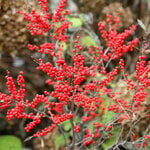
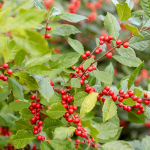 Ilex verticillata Berry Heavy®
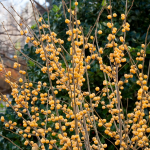 Ilex verticillata Berry Heavy® Gold